I Kept Forgetting Things So I Built My Personal System
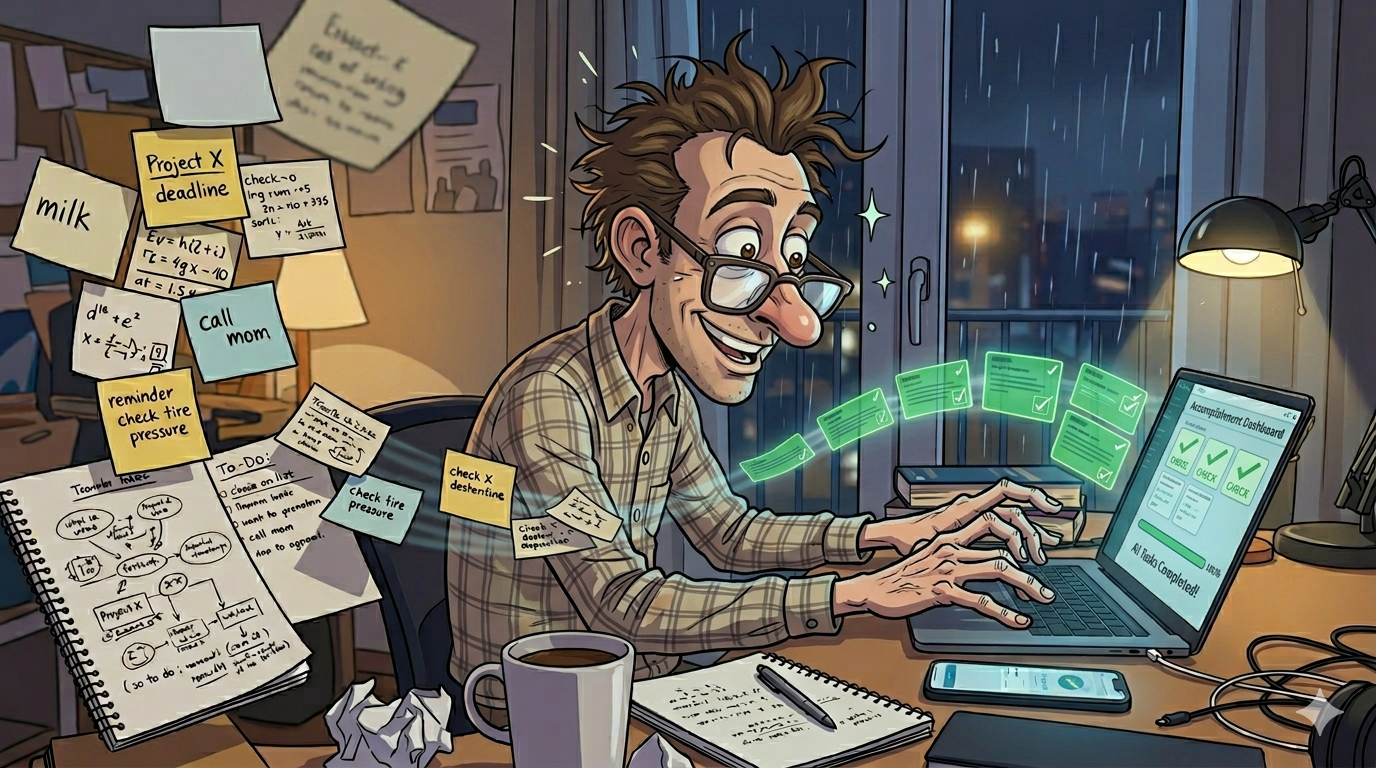
For a long time, I thought I had a discipline problem. But the truth was simpler: I was carrying too many open loops in my head.
I would get an idea, save it somewhere random, and lose it when it mattered. I would remember a task at the wrong time and forget it later. Even small daily things like shopping would slip.
It was not one big failure. It was repeated small misses that created stress, guilt, and mental noise.
What My Days Actually Looked Like (Before I Started Fixing It)
In one week, I captured ideas in three different places:
- one in notes
- one in a message to myself
- one on paper
By the weekend, I had fragments, not clarity. I could remember that I had "something important," but not the full thought, why it mattered, or what to do next.
The same pattern happened with tasks and personal errands. Nothing was impossible. Everything was just slightly harder than it needed to be.
Why Normal To-Do Apps Did Not Solve It For Me
I do not think to-do apps are bad. I think most of them assume a cleaner life than the one we actually live.
In real life, my problem was this:
-
Capture was too slow at the moment I needed it.
If an idea comes while walking, talking, or switching contexts, even small friction is enough to lose it. -
Everything was split across tools.
Notes, reminders, chat, calendar, and random paper lists were not connected. -
I lost context, not just tasks.
A task without context becomes noise.
"Do this" is weak.
"Do this because..." is actionable. -
Review was optional, so it rarely happened.
Without a simple review rhythm, lists quietly become graveyards.
Why I Used This Project to Learn AI Too
At the same time, I wanted a practical way to learn AI by building something real, not just watching tutorials.
So instead of starting a random demo, I used my own daily pain as the use case. This project became both:
- a personal system to reduce forgetfulness
- a hands-on AI learning lab connected to real life
That gave me motivation to keep building, because every improvement was useful immediately.
So I Stopped Looking for "One Better App"
I stopped looking for a single app that would "fix me." Instead, I started building a small system that can hold real life when life is messy.
The goal is not perfect productivity. The goal is fewer lost ideas, less mental noise, and faster decisions.
What I Am Building (Phase 1)
I am not building a fancier to-do app. I am building a closed loop that makes it harder for important things to disappear.
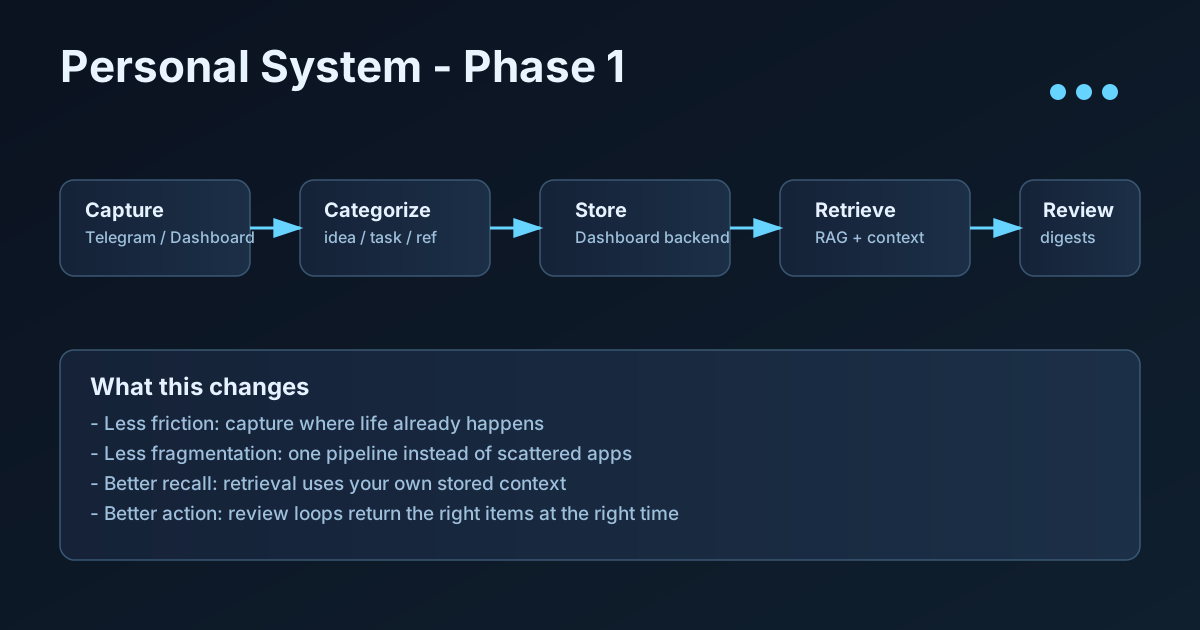
The phase-1 loop is straightforward:
- Capture via Telegram (primary) or dashboard inbox (manual fallback).
- Categorize each item (idea / task / reminder / reference) with basic context.
- Store it in the dashboard backend as structured data.
- Index important text for semantic retrieval.
- Retrieve + Review through query flows, digests, and reminders.
That design is the core advantage: less friction to capture, less fragmentation, more context, and faster retrieval when I need to decide.
Where RAG Helps
RAG (Retrieval-Augmented Generation) is the part that makes answers more personal and less generic.
Instead of answering from model memory alone, the system first retrieves relevant pieces from my own stored context, then generates a response from that. So the answer is based on what I actually captured, not abstract advice.
It is useful, but not magic:
- If I did not capture something, the system cannot retrieve it.
- Retrieval quality still needs tuning in early phases.
- The loop only works if capture and review stay consistent.
This is still phase 1, but it already reduces lost ideas, mental overhead, and time spent searching across scattered tools.
What I Am Trying to Improve Next
I am currently improving four technical areas:
- Telegram voice capture: turn voice messages into text automatically, then run the same categorization path as text messages.
- Better categorization quality: improve confidence thresholds and add clearer fallbacks when an item is ambiguous.
- Retrieval ranking: tune retrieval so recent and high-signal items are prioritized when context is dense.
- Review automation: make daily/weekly digests more actionable (fewer noisy items, clearer next actions).
This is still phase 1. I am not presenting a finished framework. I am sharing a real process: what breaks, what improves, and what actually holds in daily life.
I will publish more updates as the system evolves, including what worked, what failed, and what changed my mind.
If you also feel mentally overloaded, I would love to know: what keeps breaking in your current system?